
Venue
Conference Hall on 3rd Floor of Material Science Research Building (Section B&C), East Campus of USTC
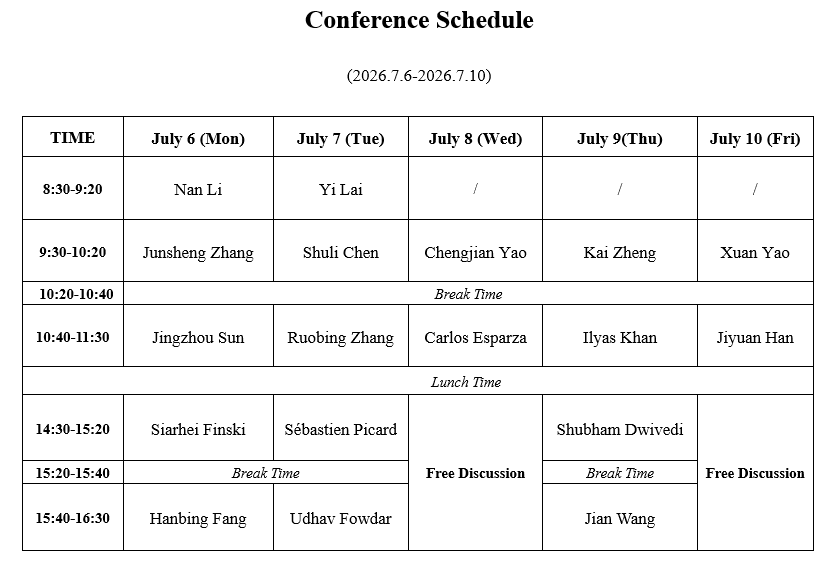
Schedule (preliminary version)
Titles & Abstracts
Shuli Chen (The University of Chicago)
Title: Optimal decay constant for complete manifolds of positive scalar curvature with quadratic decay
Abstract: We prove that if an orientable 3-manifold M admits a complete Riemannian metric whose scalar curvature is positive and has at most C-quadratic decay at infinity for some C > 2/3, then it decomposes as a (possibly infinite) connected sum of spherical manifolds and S2×S1 summands. Consequently, M carries a complete Riemannian metric of uniformly positive scalar curvature. The decay constant 2/3 is sharp, as demonstrated by metrics on R2×S1. Thisimproves a result of Balacheff, Gil Moreno de Mora Sarda, and Sabourau, and partially answers a conjecture of Gromov. The main tool is a new exhaustion result using μ-bubbles.
Shubham Dwivedi (University of Hamburg)
Title: Ricci-harmonic flow of G2-structures
Abstract: We will talk about a new general flow of G2-structures which we call the Ricci-harmonic flow. The flow is a natural coupling of the Ricci flow of underlying metrics and the isometric flow of G2-structures but with explicit lower order terms. We will explain how to obtain the lower order terms and how the flow can be interpreted as an analog of the Ricci flow of metrics for G2-structures. We will discuss various analytic and geometric results for the flow including short-time existence and uniqueness of solutions, regularity theory and long time existence results. Time permitting, we will also talk about explicit solutions and singularities of the flow. The talk is based on arXiv:2601.05210 and arXiv:2601.16832 (joint with Ragini Singhal).
Carlos Esparza (UC Berkeley)
Title: Existence and uniqueness of asymptotically conical shrinker Kähler-Ricci solitons
Abstract: We prove the uniqueness up to automorphisms of asymptotically conical Kähler-Ricci shrinkers on a fixed noncompact complex manifold M and derive obstructions to their existence. In particular, M needs to be a K-polystable polarized Fano fibration in the sense of Sun-Zhang. Joint work with Charles Cifarelli.
Hanbing Fang (Stony Brook University)
Title: Ricci flow limit space and its singular set
Abstract: Ricci flow is a powerful tool for studying the geometry and topology of smooth manifolds. In this talk, we focus on closed Ricci flows with a uniform lower bound on entropy. We first present a weak compactness theorem for the moduli space of such flows, each equipped with a natural spacetime distance, under pointed Gromov–Hausdorff convergence. The limiting object is referred to as a noncollapsed Ricci flow limit space. We then discuss its structure theory and analyze the singular sets. In particular, we describe a strong uniqueness theorem for the cylindrical tangent flow based on a Łojasiewicz-type inequality. From this, we can further establish that the cylindrical singular set is k-parabolic rectifiable. In dimension four, we prove that the singular set is 2-parabolic rectifiable, together with an integral estimate at the first singular time. This resolves Perelman's bounded diameter conjecture for three-dimensional closed Ricci flows. This talk is based on joint work with Yu Li.
Siarhei Finski (École Polytechnique)
Title: Kodaira-Iitaka dimension and multiplicity: an analytic perspective
Abstract: We express the Kodaira-Iitaka dimension and the multiplicity of graded linear series in terms of the intersection theory of the plurisubharmonic envelope associated with the linear series, and obtain two refined versions of these formulas at the pointwise and at the metric levels. At the pointwise level, we focus on the weak convergence of the partial Bergman kernel associated with the linear series and a Bernstein-Markov measure. At the metric level, we compute the asymptotic ratio of the volumes of unit balls defined by the sup-norms on the linear series. Based on our findings, we introduce a non-pluripolar version of the numerical Kodaira-Iitaka dimension for a line bundle, show that this invariant dominates the classical Kodaira-Iitaka dimension and is, in turn, bounded above by the numerical versions proposed so far.
Udhav Fowdar (University of Warsaw)
Title: The holonomy of the Obata connection on Joyce hypercomplex manifolds
Abstract: The Obata connection is the unique torsion free connection preserving a hypercomplex structure; it can be viewed as the hypercomplex analogue of the Levi-Civita connection on Riemannian manifolds. While a lot is known about Riemannian holonomy groups (including a full classification), very little is known about the Obata holonomy group. In this talk, I will present some new results exploring the Obata holonomy on compact Lie groups endowed with left invariant hypercomplex structures. The talk is based on a joint work with Beatrice Brienza, Giovanni Gentili and Luigi Vezzoni.
Jiyuan Han (Westlake University)
Title: On the H-minimizer of a Fano Fibration germ
Abstract: On a Fano variety, the Hamilton–Tian theorem predicts that the normalized Kähler–Ricci flow converges to a unique limit — a shrinking Kähler–Ricci soliton. The H-minimizer plays an important role in characterizing this limit. In recent work, Song Sun and Junsheng Zhang proved that any complete shrinking Ricci soliton is quasi-projective, which also suggests the potential ability of algebraic methods in studying the finite-time singularities of the Kähler–Ricci flow. In joint work with Lu Qi, Minghao Miao, Linsheng Wang, and Tong Zhang, we establish the existence and uniqueness of the H-minimizer for a Fano fibration germ, generalizing the known result for Fano varieties.
Ilyas Khan (Duke University)
Title: Existence and uniqueness of asymptotically conical G2-Laplacian flows
Abstract: Bryant's Laplacian flow of closed G2-structures has been proposed as a parabolic PDE approach to the problem of finding Riemannian metrics with holonomy G2 on 7-manifolds. A central issue regarding this approach is the following question: which classes of initial conditions admit a flow, even for a short time? This short-time existence property was established in 2011 by Bryant and Xu for closed G2-structures on compact manifolds. In this talk, we'll discuss a similar existence result for flows of closed, asymptotically conical G2 structures on non-compact manifolds.
Yi Lai (UC Irvine)
Title: Classification of ancient cylindrical mean curvature flows and the Mean Convex Neighborhood Conjecture
Abstract: We resolve the Mean Convex Neighborhood Conjecture for mean curvature flows in all dimensions and for all types of cylindrical singularities. Our proof relies on a complete classification of ancient, asymptotically cylindrical flows. We prove that any such flow is non-collapsed, convex, rotationally symmetric, and belongs to one of three canonical families: ancient ovals, the bowl soliton, or the flying wing translating solitons. This is joint work with Richard Bamler.
Nan Li (City University of New York)
Title: A Canonical Proof of Perelman's Stability Theorem
Abstract: Perelman's remarkable stability theorem states that if X is a compact n-dimensional Alexandrov space with curvature ≥ k, then for any ε >0, there exists δ = δ (X, ε)>0 such that for any n-dimensional Alexandrov space Y with curvature ≥ k (e.g. manifold with sec ≥ k), if Y is Gromov-Hausdorff close to X by a δ -approximation f: X → Y, then there is a homeomorphism g: X → Y which is ε-close to f.
We present a new and canonical proof of this result, which may help to improve Perelman’s Stability Theorem.
Sébastien Picard (University of British Columbia)
Title: Special Lagrangian submanifolds and circle collapse on K3
Abstract: We consider K3 surfaces degenerating to a three-dimensional affine base. We discuss how straight lines on the base lift to degenerating sequences of special Lagrangian two-spheres. The proof involves a gluing construction of compact special Lagrangians. This is joint work with Federico Trinca.
Jingzhou Sun (Shantou University)
Title: On the Bergman kernel of complex manifolds of constant holomorphic sectional curvature
Abstract: We will talk about our recent result on the Bergman kernel of polarized complex hyperbolic manifolds and polarized abelian varieties.
Jian Wang (University of Chinese Academy of Sciences)
Title: Rigidity results of Ricci-flat asymptotically locally flat 4-manifolds
Abstract: There are many examples of Ricci-flat asymptotically locally flat (ALF) 4-manifolds, such as the Schwarzschild and Taub-NUT metrics. However, a complete classification of Ricci-flat ALF 4-manifolds up to isometry remains open. In this talk, we will discuss Ricci-flat ALF 4-manifolds admitting a uniformly bounded killing field and give a classification for such 4-manifolds. The proof is based on the argument of Mars-Simons. This is joint work with Marcus Khuri and Mingyang Li.
Chengjian Yao (ShanghaiTech University)
Title: Closed G2-structure with T3-symmetry and Hypersymplectic structures
Abstract: We use canonical decomposition of G2-structure adapted to 3-dimensional subspaces to study closed or torsion-free G2-structure with effective T3-symmetry. Closed G2-structures are roughly classified into two types according to the orbits being non-isotropic or isotropic. The action is almost-free and the the orbit space is a good hypersymplectic orbifold with cyclic isotropic groups in the first type. The action is locally multi-Hamiltonian in the second type, and the open and dense subset of principal orbits is foliated by T3-invariant hypersymplectic manifolds. For complete torsion-free G2-structures, we prove several Liouville type theorems under certain geometric assumptions. This is based on the joint work with Ziyi Zhou.
Xuan Yao (Princeton University)
Title: A positive mass theorem for continuous metrics
Abstract: Let 𝒈 be continuous metric on ℝ3 which is asymptotically flat in the sense that

for some τ >1/2. Further assume that 𝒈 can be uniformly approximated on compact sets by smooth metrics with almost non-negative scalar curvature. For such a metric 𝒈. we define a synthetic ADM mass using harmonic functions. The harmonic mass m (𝒈) coincides with the usual ADM mass whenever g is smooth and decays rapidly enough that the latter is defined. The harmonic mass can also be computed as a limit of the C0 local mass introduced by Burkhardt-Guim. Our main result is a positive mass theorem: the harmonic mass satisfies
m(𝒈)≥0,
and if m (𝒈)=0 then 𝒈 is flat.
Junsheng Zhang (New York University)
Title: Gromov-Hausdroff limits of immortal Kähler-Ricci flows
Abstract: We show that the normalized Kähler-Ricci flow on a compact Kähler manifold with semiample canonical bundle converges in the Gromov-Hausdorff topology to the metric completion of the twisted Kähler-Einstein metric on the canonical model, as conjectured by Song-Tian. This is based on joint work with Man-Chun Lee and Valentino Tosatti.
Ruobing Zhang (University of California San Diego)
Title: Geometric structures of metric measure spaces
Abstract: This talk centers around metric measure spaces with low regularity. We will investigate the regularity of the induced Riemannian structure, and we will establish a series of structural theorems for such metric spaces. These results are new even in the setting of smooth manifolds and in the context of Alexandrov spaces.
Kai Zheng (University of Chinese Academy of Sciences)
Title: On the structure of complete G2-solitons
Abstract: In this talk, we will present compactness theorems for complete gradient G2-solitons under the assumptions of a lower bound on the scalar curvature and a broad growth condition on the potential function associated with the gradient vector field. After first showing Gromov-Hausdorff convergence for such sequences, we will sharpen this result by deriving epsilon-regularity estimates. As a consequence, we will obtain smooth convergence provided there is a uniform energy bound at half the dimension.

版权所有 ©中国科学技术大学几何与物理研究中心
地址:安徽省合肥市金寨路96号邮编:230026 201315
上海市浦东新区康桥镇秀浦路99号
电话:+86-551-63606117
友情链接
